
The Roman mosaic and international studies
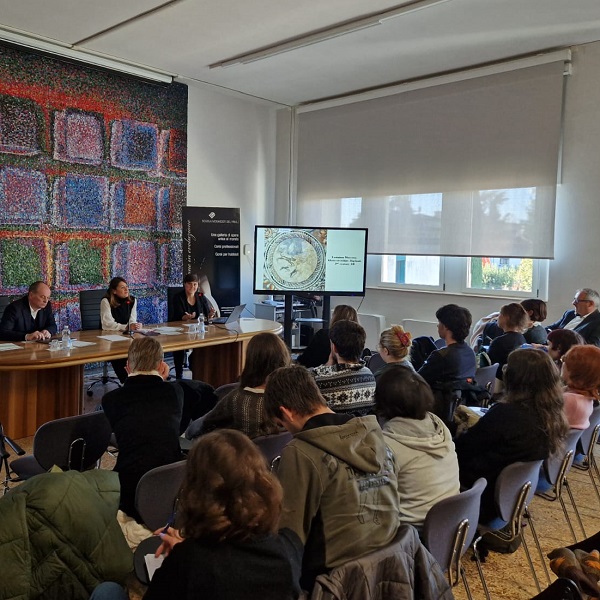
The international conference Mosaic in Roman times: art and technique was hosted today morning, Thursday 14 November 2024, at the Scuola Mosaicisti del Friuli.
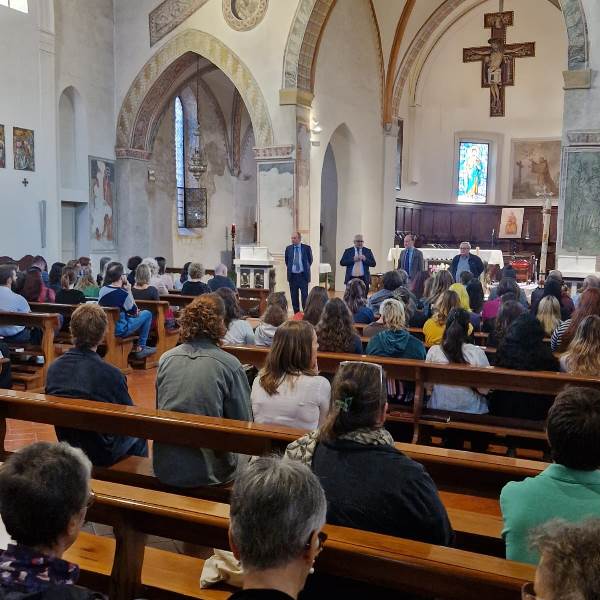
Initiative in its second edition, sponsored by the Consulate General of Romania in Trieste, and curated by the Museum of National History and Archeology of Constanta, by the Center for the Studies of Black Sea Civilizations in Romania and by the Institute of the Romanian Language of Bucharest with the collaboration of the Scuola Mosaicisti del Friuli, offered the public, where scholars, tourist guides and all the teachers and students of the School were present, an intense morning of study on the techniques, functions, the iconography, the places of the Roman mosaic read with a European gaze. Expressions and forms in fact find continuity, albeit with due local differences, within the vast Roman Empire, which allows us to establish a profitable supranational exchange between archaeologists, researchers, historians and restorers in the present. In this dense network of relationships, it is the museums and archaeological sites that conserve the mosaic heritage of greatest interest which, if compared and contextualized, constitutes an inexorable source of information.
After the welcome by Stefano Lovison, president of the Scuola Mosaicisti del Friuli, followed by greetings from: Enrico Sarcinelli, mayor of Spilimbergo; Adina Lovin, Consul General of Romania in Trieste; Roberto Corciulo, President of the Aquileia Foundation.
The works, coordinated by the director of the Scuola Mosaicisti del Friuli, Gian Piero Brovedani and by Adriana Ioana Opriș, collaborator of the Romanian Language Institute of Bucharest, opened with the report by Danila Venuto, professor of mosaic history at the Mosaic School from Friuli, who made an excursus on the Roman mosaic accompanied by a rich repertoire of images, to then focus on the testimonies present in Italy; the consonances, but also the geographical and technical peculiarities of the Greek, Roman and Byzantine mosaics in Dobruja (Romania) are evident, studied in depth by Irina Sodoleanu of the Museum of National History and Archeology of Constanta; Mario Cesarano, director of the Aeclanum archaeological park, spoke about the Aeclanum site, in Mirabella Eclano, in the province of Avellino, illustrating the unprecedented mosaic with central rose window of the spa building; closing the morning of studies was the archaeologist and curator of the Museum of National History and Archeology of Constanta, Oana Grigoruță, with a brilliant discussion of the figure of the dog in the Roman mosaic, starting from the motto of the “cave canem”, that “Beware of the dog” on the floor of Pompeii, he then recounted, referring to mosaic images and other artistic forms of the Roman world, anecdotes, customs, types of breeds, functions and man’s love, unchanged over the centuries, for his faithful and furry four-legged friend.
The interventions, enriched by numerous images, as well as the discussion between scholars, involved the public until the end. For the students of the School, in particular, it was an important opportunity for in-depth study from which they drew ideas and considerations, as well as suggestions on a mosaic, the Roman one, which in addition to geometric, decorative and figurative motifs, can also suggest a lot to us on solutions technical and executive measures implemented such as to still allow its existence.
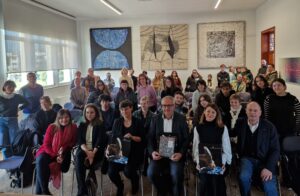
Speakers and audience at the end of the morning of studies. From left: Danila Venuto, Irina Sodoleanu, Oana Grigoruță, Mario Cesarano, Adriana Ioana Opriș, Gian Piero Brovedani.
November 14, 2024