
The 106th academic year of the Scuola Mosaicisti del Friuli begins
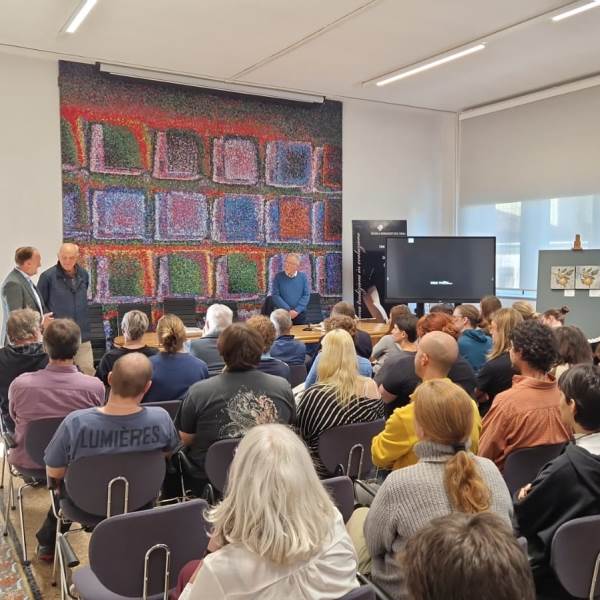
The 106th academic year of the Scuola Mosaicisti del Friuli began this morning, Monday 28 September 2026.
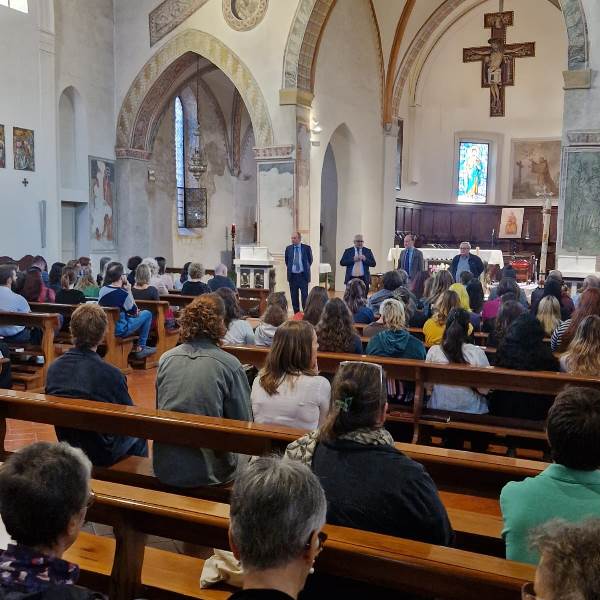
As is customary, it opened with an inaugural ceremony at the Church of Saints Joseph and Pantaleon, a symbolic site in the town of Spilimbergo which houses, amongst other things, a mosaic Via Crucis dating from the 1960s and, on the exterior, the more recent work from 1999, Le litanie della Vergine (The Litany of the Virgin), based on a design by Mario Deluigi; both were created by the Scuola Mosaicisti del Friuli.
In addition to all the students, teachers and administrative staff of the School, the event was attended by various representatives of the organisations that make up the Consortium for the Scuola Mosaicisti del Friuli, representatives of the Regional Directorate for Labour, Training, Education and Family, leading figures from Spilimbergo’s art and cultural scenes, and historic master mosaicists who, in their youth, had studied at the School before going on to become entrepreneurs in the mosaic sector.
The ceremony opened with a speech by the president of the Scuola Mosaicisti del Friuli, Stefano Lovison, who, in greeting those present, made a point of addressing the students in particular, welcoming them and recalling how the School is made up of a team of people who work together to ensure that the quality of the training programme offered remains consistently high.
The mayor of Spilimbergo, Enrico Sarcinelli, also addressed the students, wishing them a year of achievements and satisfaction, after which Father Giorgio Bortolotto encouraged the young people to be curious and passionate.
The director of the Scuola Mosaicisti del Friuli, Gian Piero Brovedani, introduced the teaching staff, outlining the various subjects of study and the skills to be acquired over the course of the three-year advanced vocational training programme to become a Master Mosaic Artist. A craft-based and artistic profile – a professional in the art of mosaic-making that attracts many young people from all over the world: indeed, all places available for the first course in the 2026/2027 academic year are now filled, with students coming from various parts of Italy, as well as from France, Germany, Belgium, Poland, Russia, Tunisia, Lebanon and Sri Lanka.
In total, the students who are today beginning the 106th academic year at the Scuola Mosaicisti del Friuli are divided into three courses within the vocational training programme, in addition to an advanced course dedicated to a number of students who qualified as Master Mosaic Artists last year. A glance at their names reveals the School’s international character. Forty-six per cent of the students come from abroad, of whom 27 per cent are European citizens. They come from Germany, France, Poland, Romania, Hungary, Belgium, Moldova, and also from Russia, the United Kingdom, Australia, Vietnam, Egypt, Syria, Iran, and the aforementioned Tunisia and Sri Lanka.
There are, of course, Italian students too: more than half live in the Friuli-Venezia Giulia region and fell in love with mosaics whilst visiting the School with their families or on a school trip. The students learn all styles of mosaic art with equal dedication: Roman, Byzantine, modern (reverse on paper) and contemporary, as well as techniques for terrazzo, terrazzo flooring, installation and laying, and finishes. These practical workshops are complemented by the study of theoretical subjects necessary for the conception and design of mosaic works: drawing and colour theory, computer graphics, applied geometry, history of the mosaic, materials technology, digital modelling, documentation and promotion. This is a comprehensive training programme developed over the years and constantly evolving in line with aesthetic requirements and the demands of the labour market. It equips professional craftspeople with all the necessary skills to enter directly – as the statistics show – into the production activities of established mosaic art workshops in Italy and abroad.
This year, a new initiative has been introduced alongside the vocational training programme for Master Mosaic Artists. Indeed, the ceremony was also attended by the ten or so participants on the first two-year course for Cultural Heritage Restoration Technicians – specialising in stone, mosaic and related materials – which is based at the Scuola Mosaicisti del Friuli itself. Hailing from art schools across the region or from humanities degree programmes, some of these aspiring ‘restorers’ are former pupils of the Scuola Mosaicisti del Friuli and are now returning to add a specialisation in the restoration and conservation of stone and mosaic works to their profession as Master Mosaic Artists. The course, funded by the Friuli Venezia Giulia Region, trains students to become nationally recognised specialist technicians, with their own professional register managed by the Ministry of Culture. The restoration technician is able to work in the fields of conservation, maintenance and restoration, applying appropriate methodologies and techniques, and carrying out preventative and curative interventions on mosaic and stone works, beginning with a preliminary study of the artefact and an analysis of its historical, artistic and conservation context.
With their timetables already in hand, the students on the restoration course are preparing for the theory and practical sessions that will take place at the School, before moving on in the spring for a work placement – accounting for a full third of the course – at the archaeological sites in Aquileia, thanks to close collaboration with the Aquileia Foundation.
The ceremony concluded with the presentation of two awards, generously donated by Marco and Nicoletta Donà, representatives and owners of the historic Mario Donà & Figli Artistic Glassworks, which was founded in Venice and moved to Spilimbergo in the 1990s at the behest of Mario Donà. Two students who have distinguished themselves through merit and passion – Giulia Rossi and Jacopo Besseghini – were honoured, and they begin their final year with this prize: a shopping voucher worth 500 euros each, which will enable them to purchase mosaic materials, including the precious Venetian enamels produced by the Donà company.
The 2026/2027 academic year therefore promises to be a rich and varied one, with around ninety students bringing the School’s workshops to life.
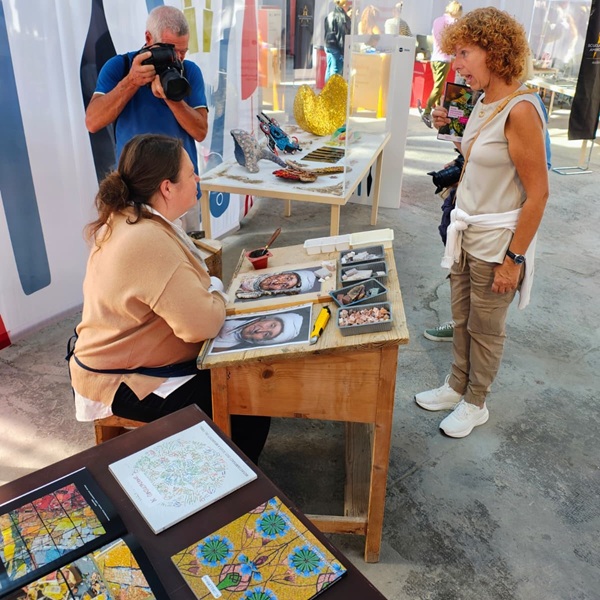
As always, however, the Scuola Mosaicisti del Friuli will be open to anyone wishing to find out more about what is taught and learnt there, to those who wish to observe a learning method based on direct experience and on the importance of craftsmanship – unique, unrepeatable and of the highest quality – to those curious to understand how teachers and students interact whilst developing projects together, and above all to those who wish to see how mosaic-making is an experience for building relationships and friendships in the spirit of respect and multiculturalism.
September 28, 2026