
200 years on from the birth of Gian Domenico Facchina
The Scuola Mosaicisti del Friuli celebrates the father of modern mosaic art
On 13 October 1826, Gian Domenico Facchina was born in Sequals; he was a world-renowned mosaic artist and a charismatic figure as an entrepreneur, artist and craftsman.
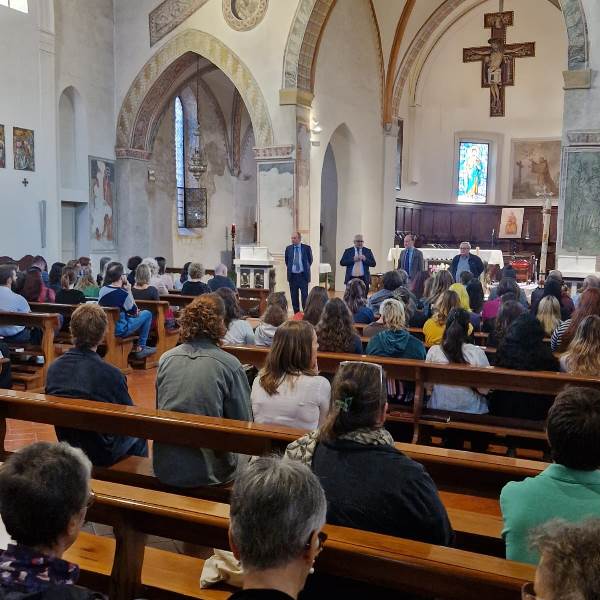
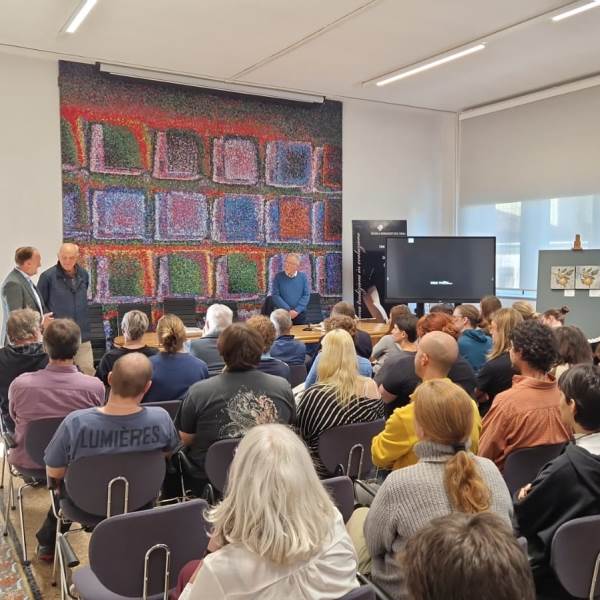
Today, two hundred years on from Facchina’s birth, the Municipality of Sequals chose to commemorate its illustrious fellow citizen at the Scuola Mosaicisti del Friuli with a presentation curated by Leonardo Zecchinon, a local history enthusiast, author and researcher, who, in great detail, traced Facchina’s biography, highlighting his witty spirit, technical skills, vision and the confidence he had in his role as a mosaic artist and in his work. A documentary then traced Facchina’s successful career across Friuli, the opulent city of Venice and France, particularly the great capital, Paris.
As a young man, Gian Domenico Facchina worked as an apprentice to an uncle; he then studied drawing and moved to Venice, where he was employed on building sites restoring important mosaics such as those in St Mark’s Basilica. It was his work in restoration that took him to the south of France in 1847: in this field, he introduced and patented, in 1858, methods for the ‘removal and re-laying of ancient mosaics without alteration’, namely techniques involving the use of gauze and adhesive. He achieved true fame, however, in Paris, where, working for the architect Charles Garnier in his workshop, he produced all the mosaic work for the Opéra, the grand new theatre commissioned by Napoleon III. Facchina adopted an innovative solution, derived precisely from his restoration work: creating the mosaics in reverse on paper in the studio and then, at a later stage, applying them to the walls. This method proved successful precisely because it reduced the time required for on-site work. Following the Opéra’s inauguration in 1875 and its resounding success, Facchina divided his time between Venice and Paris. In Venice, he had a workshop in Palazzo Labia and founded a kiln to produce the raw material for mosaics – enamel – which he entrusted to his collaborator Angelo Orsoni. The economic situation in Europe led him to leave Venice and settle permanently in Paris, where he died at the age of 76 and was buried in the Père-Lachaise Monumental Cemetery.
His son and son-in-law, the heirs to the Facchina business, would not possess the same creativity or foresight as Gian Domenico Facchina, a mosaic artist who, in the second half of the nineteenth century, left behind mosaics in prestigious locations across five continents; to name but a few: the dome of St Paul’s in London, the Metropolitan Museum of Art in Chicago, the Vanderbilt Villa in New York, the Basilica of Notre Dame de Sion in Jerusalem, the fifteen chapels of the Sanctuary of Lourdes, the Imperial Palace in Kyoto, and other works in Algiers, Buenos Aires, The Hague, Bucharest, St Petersburg and the major French cities.
At the conclusion of this heartfelt celebratory event, the Award named after the famous mosaicist was presented; it is conferred annually by the Municipality of Sequals to two students from the Scuola Mosaicisti del Friuli who have distinguished themselves in the final project of their first-year course. The 2026 Facchina Award was presented to two students: Lisa Benini from Campoformido and Anastasia Smirnova from Sovetskiy (Russia). Both created a mosaic, in the Roman style and using natural materials, depicting an orange twig taken from an ancient painting. Visibly moved as they received the award from Mayor Enrico Odorico, the two students – currently in their second year – thanked the Municipality of Sequals and the School, in particular their first-year tutors Francesco Anchora and Jonas Giubbini.
There could therefore be no better way to honour the man who ushered the art of mosaics into the age of progress and modernity. An educational event for the students, as highlighted by the president of the Scuola Mosaicisti del Friuli, Stefano Lovison, to explore this figure of international stature, whose legacy the Scuola Mosaicisti del Friuli has inherited: indeed, when the School was founded in 1922, it was none other than a colleague of Facchina’s, Andrea Avon, who became a mosaic tutor, and the School has never ceased to teach the indirect technique – that reverse-on-paper method devised by Gian Domenico Facchina.
The event was also a joyful occasion with the presentation of the Award. The two selected mosaics will be exhibited, as is customary, for a year in the entrance hall of Sequals Town Hall, that is, until the next edition: an incentive for the students on the first course to work with commitment and determination – the very determination that enabled Facchina to stand out amongst the many mosaicists and terrazzo artists of Friulian origin who worked throughout Europe in the nineteenth century.
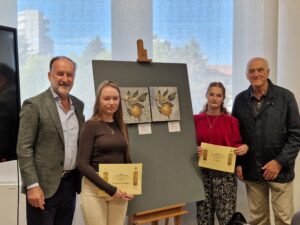
Chairman Stefano Lovison, the winners of the Facchina Prize, Anastasia Smirnova and Lisa Benini, and the mayor of Sequals, Enrico Odorico.
October 13, 2026