
Mosaico&Mosaici 2025
The great annual exhibition of the Scuola Mosaicisti del Friuli
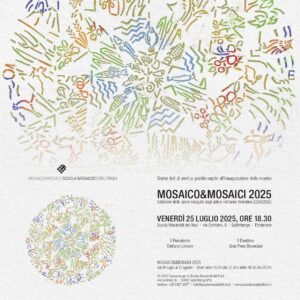
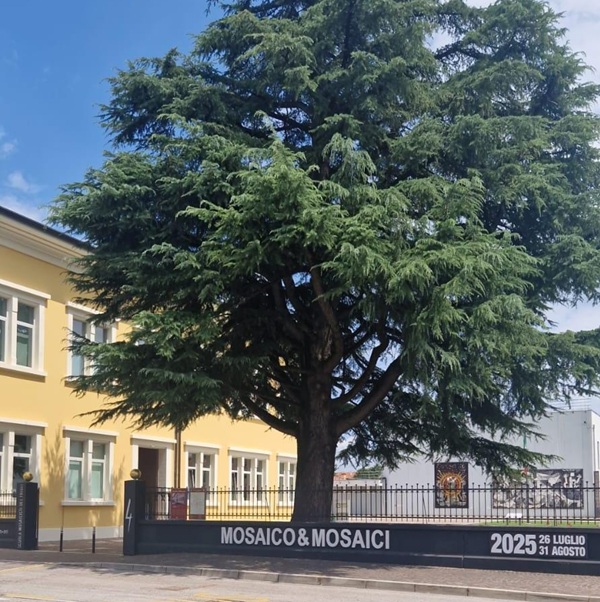
On 25 July 2025, as is traditional on the last Friday in July, the Scuola Mosaicisti del Friuli will inaugurate the exhibition Mosaico&Mosaici 2025 – 103rd training year, the annual event that transforms the school into a large exhibition space.
This is the 31st edition of an event that opens with a grand inaugural celebration and attracts visitors from all over, not just from the region, recording a record number of visitors for a single month of opening (over 6,000 visitors in 2024).
The success of the exhibition is a well-established formula, but at the same time it is always new, appealing to loyal visitors as well as those who come to the Scuola Mosaicisti del Friuli for the first time.
Visitors are taken on a journey through history, that of the recently concluded 2024/2025 academic year, which reflects the evolution of mosaic art. The exhibition is structured around four styles, identifiable by their compositional choices and technical methods: Greco-Roman, Byzantine, modern and contemporary. These four forms of expression are the subject of study for the school’s students and are taught in the three-year professional course.
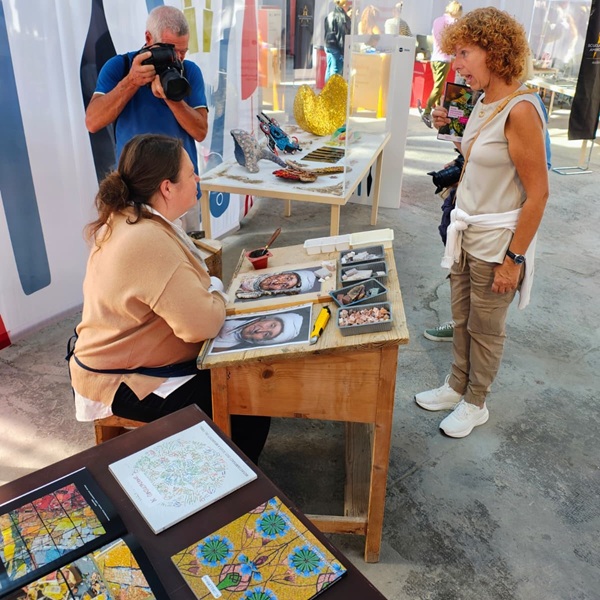
Visitors can admire a selection of works, samples, experimental trials and creative genius produced by students at the Scuola Mosaicisti del Friuli, either individually or in groups, exploring different aspects of mosaic and terrazzo.
The exhibition is therefore an opportunity for sharing and discussion between those who work at the school and the outside world. A selection of what has been done during the nine months of training is showcased: from traditional techniques to innovative proposals. This exhibition is therefore a manifestation of the vitality of mosaic, of its being a contemporary art, capable of renewing itself and keeping pace with every form of expression and communication. The result of study, hard work and passion, it is an opportunity for the students and teachers of the School to demonstrate their commitment and reap the rewards.
While the Scuola Mosaicisti del Friuli proudly recalls its more than a century of existence, it is equally proud to note that over the decades, Mosaico&Mosaico has taken on the appearance of a major exhibition, with elegant displays, explanatory notes, multimedia materials, various types of visitor support, and an internationally recognised mosaic art event.
The secret of its success lies precisely in its ability to present the training programme in a dynamic and enjoyable way: although structured around the acquisition of the skills necessary for future master mosaicists, each year it is applied to new and original projects. This is certainly thanks to the school’s management and teachers, who conceive mosaics that are always different, not only in terms of subject matter, but also in terms of form and function, studied and developed together with the students. This is what makes the exhibition so unique and different, creating anticipation among the numerous visitors who consider Mosaico&Mosaici one of the unmissable events of the summer.
In the spaces of the Scuola Mosaicisti del Friuli, rearranged for the occasion, visitors will be able to appreciate, every day throughout August, works created through a shared, workshop-based process that characterises the teaching method of this highly professional artistic-craft school, with students involved and participating from the design phase to the finishing touches, without neglecting even the exhibition aspects.
What we will see in this 31st edition
The tour begins, in chronological order, with the rooms dedicated to Greco-Roman mosaics, which are studied by students in the first course. The style is strictly adhered to: the tiles are made of natural materials and are square in shape; models for practising cutting and composition are taken from important examples from the past. These are small mosaics with geometric and floral decorative motifs: they reflect the compositional style of antiquity, marking the contours of the figures and filling the backgrounds in a linear fashion. Created individually by the students, these are small mosaic pictures of birds or roosters, details taken from Roman paintings.
Roman mosaics are used for flooring: among the many illustrious examples, it was decided to reproduce half of the large rose window in the assembly hall of the Palace of Hishām, an important archaeological complex north of Jericho. It has a diameter of 4 metres and features different designs: from the outer Greek fret with a curvilinear pattern to the geometric triangle designs that become smaller as they approach the centre, determining the variation in the size of the tiles from 7 millimetres in the outermost band to 3 millimetres in the central area, based on the model of the so-called opus vermiculatum, the technique used in the most admired mosaics of Pompeii.
Starting this year, Byzantine mosaic techniques will also be introduced in the first course. The representation of Noah and his three sons building the ark will offer a beautiful visual impact. The subject is taken from the dome of the Baptistery of Florence, the “Bel San Giovanni” lovingly evoked by the exiled Dante Alighieri. It was decided not to reproduce the scene slavishly on a two-dimensional panel, but to transform the individual characters into vertical silhouettes, created with Venetian enamels in Byzantine style, positioned theatrically as if on a stage.
A space is reserved for terrace trials, a subject complementary to mosaics: from rock forms in washed grit to replicas, with technical insights, of cocciopesto floors, and even the floral frieze in Venetian terrazzo. Photographic evidence documents the execution of flooring for the School, which has always been used as a testing ground, a privileged place to start small construction sites for the improvement or beautification of common areas. This gives students the opportunity to try their hand at concrete and realistic situations that they will encounter as craftsmen in the future. Here they are photographed applying mosaic to the floor of the east entrance ramp of the School or spreading grit in the creation of the terrazzo floor on the first and second floors of the New Gallery of the Scuola Mosaicisti del Friuli (former Carabinieri barracks building).
Bright, colourful mosaics, created using Venetian enamels and gold tiles, illuminate the spaces dedicated to medieval and modern styles, where light is the true protagonist of the works covered in the second course. There are large panels inspired by two miniatures from the Book of Kells, a manuscript written by Irish monks around 800 AD, a masterpiece of early medieval art from the British Isles. Each student also created a mosaic icon with a Marian subject and, again in Byzantine style, portraits of sacred figures with vivid expressions and precious details. It is essential for a mosaicist to learn to work individually, but also in a group when the size of the work requires it: it is therefore easy to be enchanted by sequences of mosaics that are diverse in colour and detail on the same subject, or to be amazed by monumental panels where different hands are unified in a single mode of execution in accordance with strict rules established during the design phase. The digital graphics exercises focus on the study and planning of the mosaic, but also on its dissemination and promotion, with the production of colourful brochures with effective layouts that accompany many of the works on display.
In the lessons dedicated to the indirect technique, also known as reverse on paper (a technique developed by Gian Domenico Facchina – Sequals, 1826 – Paris, 1903), author of the vast mosaic decoration of the Paris Opera, and of which the Scuola Mosaicisti del Friuli is the heir), a panel with an Art Nouveau motif was developed, based on a floral design for fabric by the Friulian artist Angiolo D’Andrea (1880-1942), who made his fortune in Milan in the early 20th century. In this technique, lively figures of cherubs also gaze out from a blue sky. The graphic female faces inspired by Sandra Pelser’s paintings are created using the direct technique and represent the beginning of portraiture, which we find in contemporary forms in the rooms of the third course with interpretations of famous self-portraits by artists.
Solutions that embrace contemporary trends and expressiveness, with variations in the field of furniture and design and different uses of materials and supports, are the topics of the third and final course, which concludes with the award of the professional qualification of Master Mosaicist. Among the many proposals, this year’s research into leather and hide stands out, thanks to the collaboration with the company DuDu Bags in Pordenone. This is an exploration of the leather goods sector with the creative challenge of weaving, rather than juxtaposing, mosaics onto leather in women’s bags, which become unique, true works of art. Then there is the large panel, a group work, a mosaic interpretation of a painting by Henri de Toulouse-Lautrec, which shows the synthesis of line and colour that mosaic art involves compared to painting. The tactile mosaic project is interesting and engaging, the result of in-depth research not without external influences, such as the meeting with the Unione Italiana dei Ciechi e degli Ipovedenti- sezione di Udine (Italian Union of the Blind and Visually Impaired – Udine section). Visitors are invited to explore the mosaic by touch, to abandon themselves to sensations, thoughts and suggestions without being influenced by what is (or is not) represented. The project covers all stages of study up to the finalisation of a “tactile mosaic” that enhances the texture and structure of the surface, determined by the shape, arrangement, inclination and size of the tiles, but also by the careful choice of materials. Another topic explored in depth in the third course, which involved several subjects, from mosaics to design and graphics, was the use of 3D modelling applied to mosaic portraiture in a sculptural key.
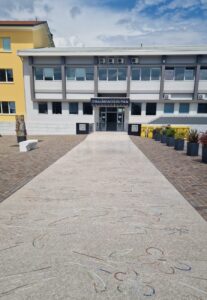
The Mosaico&Mosaici 2025 exhibition will also be an opportunity to learn about and see one of the projects on which the Scuola Mosaicisti del Friuli is currently focusing: the creation of the large outdoor floor of the Galleria della Scuola Mosaicisti del Friuli entitled Flora e Fauna in Friuli Venezia Giulia (Flora and Fauna in Friuli Venezia Giulia): a work that will cover an area of almost 1,265 square metres.
MOSAICO&MOSAICI 2025 Exhibition
26 JULY> 31 AUGUST 2025
Open daily from 10:00 a.m. to 12:30 p.m. and from 4:30 p.m. to 8:00 p.m.
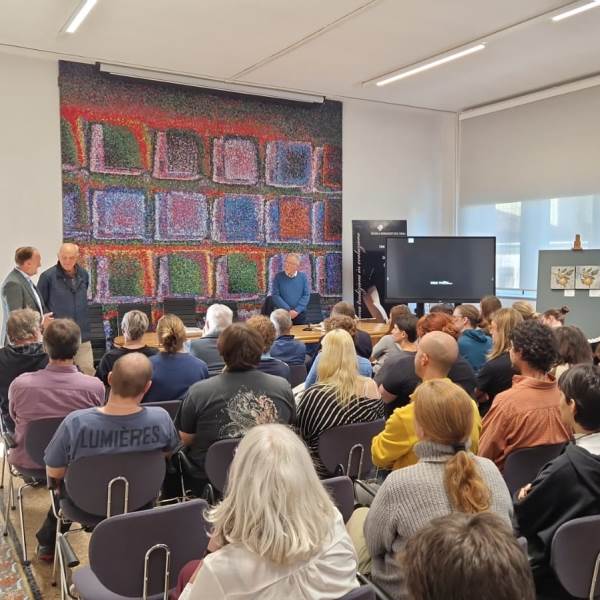
Opening Friday 25 July 2025 at 6.30pm, Spilimbergo, in the courtyard of the Scuola Mosaicisti del Friuli (in case of bad weather, at the Cinema Teatro Miotto).
MOSAICO&MOSAICI 2025 CATALOGUE
available at the exhibition
Scuola Mosaicisti del Friuli, 2025, pp.96.
July 24, 2025